
Linking Sustainability, Spirituality, and Peacebuilding

· 4 min read

A friend of mine, Sarah Talcott, recently wrote the Global Youth Cooperation Circle about an interfaith youth exchange she is planning in Cyprus. In that message she asked,

I would love to get your thoughts and ideas about how you see peacebuilding and sustainability education linked. How do the two influence and / or impact the other? How do you see these links in the work you are doing in the world? It would be nice to be able to integrate the ideas and input from this global network of young people into the exchange, as well as to take the findings and insights of the exchange back to you all.

I happened to be thinking of these very issues as I pulled dandelions up from my front yard this afternoon, so when I came inside and read her message, I felt called to respond by rapidly composing the following, which is thought-through but admittedly makes a few leaps in logic (to do otherwise would require a far larger tome!).

Abdu'l-Baha and "Ether"

· 3 min read

An interesting little discussion on the intersection of science and religion has unfolded in Special relativity and the Bahá’í Faith (dead link removed; SF 2025). In references in Some Answered Questions and elsewhere, 'Abdu'l-Bahá speaks of "ether," a concept that was abandoned by the majority of scientists with the acceptance of Einstein's special relativity. The question then is, which should we adhere to? The religious truth or the scientific one?

Fortunately I believe this is a false dichotomy, at least in this specific situation. Despite having a masters degree in physics, I’ve never been bothered by the "ether" quotation. For example, 'Abdu'l-Bahá writes:

"Reflect that light is the expression of the vibrations of the etheric matter: the nerves of the eye are affected by these vibrations, and sight is produced. The light of the lamp exists through the vibration of the etheric matter; so also does that of the sun, but what a difference between the light of the sun and that of the stars or the lamp!"

Judaic Mythology

· 3 min read

I was recently watching a show on PBS wherein the narrator was traveling the lands of ancient Canaan, illustrating the paths of Abraham in the book of Genesis. At one point he and his guide climbed a slope next to the Dead Sea, and, having entered a tunnel in the cliff-side, found themselves staring up an immense shaft blasted by salt. Due to a confluence of geographic and climactic factors, the pressure from the Sea will often push great fountains of salt up from the seabed through this shaft, and thence cover the plains above the cliff.

These very plains are one of the rumored locations of the ancient cities of Sodom and Gomorrah. The film crew left the tunnels and returned to the cliff top plains. The land was harsh; the uneducated eye would have no idea that salt covered all, preventing growth. Was this spray of salt perhaps the origin of the Bible's story of the destruction of these cities? Even more interesting to me, however, was the pillar of salt that the crew passed – just bigger than a person. "But Lot's wife looked back, and she became a pillar of salt" (Gen 19:26). Could this be she?

Review: A Sand County Almanac

· 5 min read

Completed shortly before his death in 1948, University of Wisconsin forestry professor Aldo Leopold grants his readers the supreme privilege of seeing nature through the original ecologist's eyes. Leopold was probably not the first to use the term "ecologist", nor the first to be be so branded; surely he was the first to deserve it. Though it may appear a quaint historical piece at first glance, its message is no less potent and relevant in the 21st century: nature, the land, deserves full respect and love without regard to traditional economics. Without this, effort at conservation will be a vain half-measure at best.

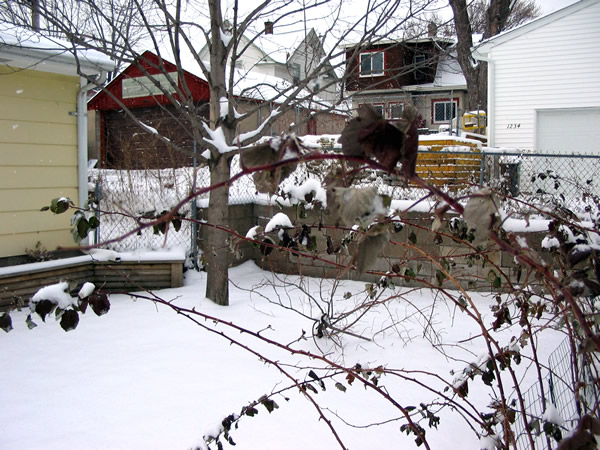
Snowfall in the backyard today

Snowfall in the backyard today

Of Man and Beast

· 3 min read

"To love what was is a new thing under the sun, unknown to most people and to all pigeons," writes Aldo Leopold in his Sketches Here and There. "To see America as history, to conceive of destiny as a becoming, to smell a hickory tree through the still lapse of ages — all these things are possible for us, and to achieve them takes only the free sky, and the will to ply our wings. In these things, and not in Mr. Bush's bombs and Mr. DuPont's nylons, lies objective evidence of our superiority over the beasts."

White People's Burden

· 2 min read

University of Texas professor Robert Jensen offers his analysis of the "white people's burden, saying in part, "That is the new White People's Burden, to understand that we are the problem, come to terms with what that really means, and act based on that understanding." He makes an interesting case, one that is completely lost on most of the commenters at this site. I suspect that many of the people responding so strongly against Jensen haven't had a good heart-to-heart with someone who has experienced racism and prejudice first-hand.

Coming to Grips With Katrina's Devastation

· 3 min read

I am sure that I am not alone in having taken a few days to fully grok the long-term affects of the devastation left by Hurricane Katrina. There were two things yesterday that made it sink in for me: 1) seeing that 25,000 people were heading to the Astrodome in Houston as refugees, expecting to be there for several months, and 2) hearing about displaced Tulane students who are taking classes at the University of Texas (and elsewhere).

The first of these two is of course the most eye-catching (and add another 25,000 heading to San Antonio). How awful, to think of joining thousands of others in sleeping on cots in the Astrodome for months, with nothing to do, no job, no privacy. That is truly horrible.

Bird Flu: Can We Out-Collaborate a Pandemic?

· 3 min read

Inspired by the WorldChanging article "Bird Flu: Can We Out-Collaborate a Pandemic?" (dead link removed; SF 2025), I want to join the blogosphere chorus for educating the public about the dangers of avian influenza. This is a nasty topic almost no one knows about. Instead of writing my own article, I've borrowed the following from one Barry Campbell and his blog Enrevanche, licensed under the Creative Commons SA 2.0.

Mass Social Change

· 4 min read

Change happens. Today is not the same as yesterday, and both are far different from a few decades ago. Nevertheless, most of us look at the troubles of the world and feel more or less hopeless than any social change will ever lessen the suffering and degradation of more than a small handful of any given populace. But change does occur. Legalized slavery was abolished in the United States. Citizens stopped hunting for witches. Democratic movements swept over the Ukraine, Georgia, Kyrgyzstan, Lebanon. Gandhi and King preached non-violence, and with non-violence achieved at least the first vital steps toward realizing their dreams. How this change comes about is the topic of an excellent essay, albeit one in need of some tightening, called The Six or Seven Axioms of Social Change.

Whirling

· One min read

Are those devils or dervishes dancing on my wingtips? I can't deny a certain...
    Beauty...
To it all;

Grace is not found in riveted
Planes of steel—
Even the birds register disapproval,
But perhaps its in a lonely red dot
Awash amidst gray and white,
Or maybe, yes, certainly
In the majesty of suspension while
Earth rolls 'round and 'round.

safnet logo