171 posts tagged with "technology"

View All Tags

Project T: Getting Started With Continuous Delivery, part 1

· 5 min read

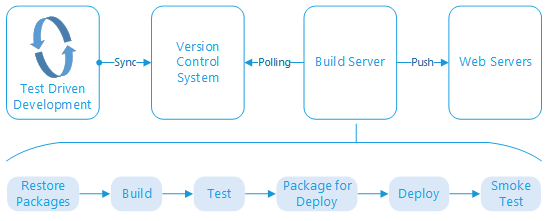
"Project T" is a temporary codename for a web application that I have begun developing off hours. Having just read The Phoenix Project, and now reading Continuous Delivery, I realized that the first step in creating a minimum viable product is to have a minimum viable process for continuous delivery, with no financial budget for that process. The solution combines a Microsoft Azure VM, GitHub, TeamCity, NuGet, Bower, Grunt, MSDeploy, and SoapUI. The result is this: as soon as I commit code to the version control system, it starts an automated chain reaction that ends with a complete install on my integration test servers.

deployment pipeline image

Studying Source Code

· 4 min read

I've been misunderstanding .NET's List<T> for years.

Two incidents this week have driven home the value of being able to study the source code of frameworks I code with. One the one hand, I was using NServiceKit.OrmLite for database access, and needed to understand how it constructs its SQL. Through study of the code, I was able to find and remediate a limitation in the wildcard handling*.

Management 3.0: Knowledge and Diversity

· 3 min read

Last year I read Jurgen Appelo's Management 3.0: Leading Agile Developers, Developing Agile Leaders. Despite taking many useful notes, I did not have the time to write up a full review / collect my thoughts on it. Overall impression: this books has tremendous value, and I recommend it highly to anyone in IT management / leadership (whether operations or software).

I look forward to re-reading it in the near future. For now, I will satisfy myself by re-collecting and re-pondering a few of those notes, starting with the topics of Knowledge and Diversity (from Ch 4 - The Information-Innovation System)

Mini E-mail Campaign With Node.js

· 3 min read

Over the weekend I had what at first appeared to be a small challenge: send out a few hundreds e-mails for a non-profit's outreach campaign. MailChimp and other mailings lists were not a good fit, as these messages were of the cold-call variety, and a formal mailing list felt too spammy. Initially I wrote a utility in .NET, but ended up solving with Node.js instead due to timeouts experienced with SmtpClient.

Node.js, Web API, and RabbitMQ. Part 4

· 4 min read

a passing test

Desiring to learn about both Node.js (particularly as an API server) and ASP.Net Web API, I decided to throw one more technology in the mix and see which one is faster at relaying messages to a service bus, namely, RabbitMQ.

Time to turn that Node.js test green. In Part 2, I succeeded in publishing a message to RabbitMQ using Node.js. However, my automated test failed: the .Net test runner could not handle the generated message. Three key elements were missing, which are required for the MassTransit .Net library to interpret the message correctly:

Node.js, Web API, and RabbitMQ. Part 3

· 5 min read

Desiring to learn about both Node.js (particularly as an API server) and ASP.Net Web API, I decided to throw one more technology in the mix and see which one is faster at relaying messages to a service bus, namely, RabbitMQ.

And now, I finally get back to blogging about the ASP.Net Web API code that I wrote for this head-to-head comparison of REST service and message bus integration. The official tutorials were my guide for Web API, and as with the test runner in part 1, I used MassTransit as a convenient library for publishing from .Net code to RabbitMQ. Owin was my solution for self-hosting the web application.

Server Side Push Notifications With SignalR

· 6 min read

Many social websites, and web-based applications, have a notification process where the server sends a signal back to the browser, informing that particular user that there is a message. "You've got mail," as America On-Line used to say it. Consider the picture below, from Twitter, which shows that I have one new notification. That number increments automatically when a new notification arrives, without having to reload the full page. How does that work? Well, this blog post doesn't try to answer that directly. In fact, it is simply a collection of notes pointing out how to use Microsoft's SignalR technology to achieve this.

example from Twitter

Node.js, Web API, and RabbitMQ. Part 2

· 5 min read

Desiring to learn about both Node.js (particularly as an API server) and ASP.Net Web API, I decided to throw one more technology in the mix and see which one is faster at relaying messages to a service bus, namely, RabbitMQ.

This is part two in a series. Part 1.

Let's start with Node.js. I already let you in on the fact that formatting a message for .Net to pick it up is tricky, and I won't get into the detail of that yet. For now, let's concentrate on setting up node.js and communicating with RabbitMQ. We'll get the finer points of interacting with .Net later.

Node.js, Web API, and RabbitMQ. Part 1

· 4 min read

Desiring to learn about both Node.js (particularly as an API server) and ASP.Net Web API, I decided to throw one more technology in the mix and see which one is faster at relaying messages to a service bus, namely, RabbitMQ. Naturally, such a test does nothing to prove that one framework is generally faster than the other, but it is a fun exercise nonetheless.

Thus the challenge is this: accept a string message via POST, forward it to the service bus, and return HTTP Status Code 202 (Accepted) along with an acknowledgment that repeats the original message. Both REST services should be self-hosted; free from additional cruft like error-handling*; and should utilize an url like http://localhost:port/Message/mymessage, where "mymessage" is the string to be sent across the bus.

safnet logo