173 posts tagged with "technology"

View All Tags

From Ad-Hoc Prompts to a Repeatable Agentic PR Review Workflow

· 5 min read

From time to time I pop in to peek at one of the dozens of pull requests that come through my mailbox daily, furthering the work of the Ed-Fi Alliance to help connect student data. What feature, improvement, or bug fix are the teams working on? How has this engineer approached a given problem, what tests have they written, what documentation have they provided, are the I/O seams sufficiently fault tolerant? Did they run the GitHub Copilot Code Review Agent, and fix the issues detected there?

tip

TL;DR Created a team of specialist reviewers skill and use it on anything non-trivial. After its analysis, it offers to post a nicely-formatted review comment on the PR. I then go back and edit that review comments, to avoid slop and/or excessive cognitive load.

Falling in Love with the CLI AI Harness

· 3 min read

For all of last year, I wondered why anyone would use the CLI version of Claude Code and similar tools. I asked a colleague about this a couple of times, and still had trouble getting it.

Until I sat down and used the CLI to perform my work. As a knowledge worker, if you haven't used copilot or claude or (favorite tool) in the terminal, you are truly missing out.

🔝 Top 3 reasons I like this experience:

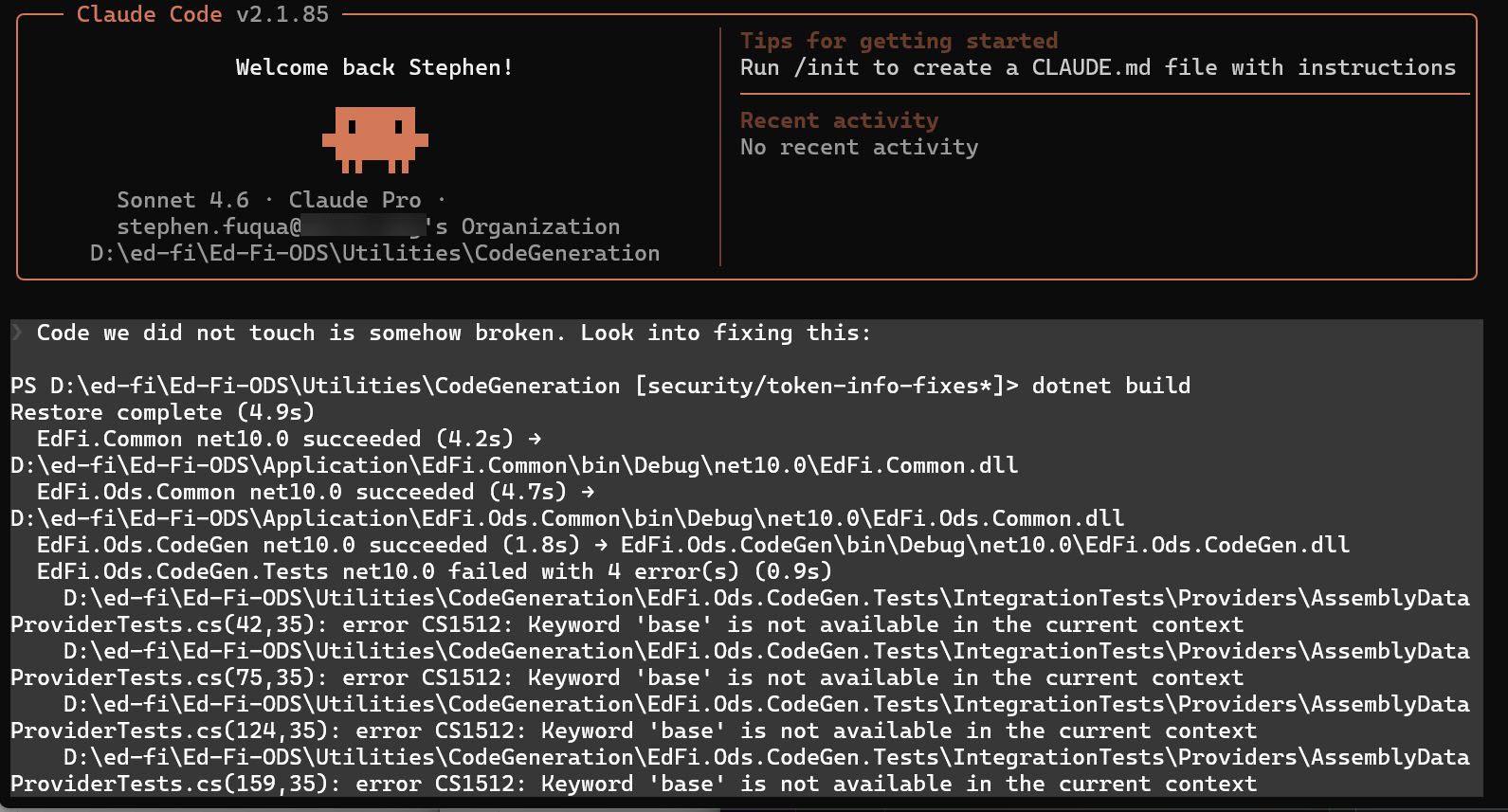
Claude Code CLI

GitHub Copilot and Signed Commits

· 4 min read

GitHub Copilot Coding Agent is an impressive and powerful tool for "autonomously" completing development tasks running in GitHub's environment. Like any tool, there is a learning curve ahead before any of us become truly high functioning, beginning with the statement of a well crafted prompt.

⚠️ But I have a concern: lack of commit signing. Should that stop us from adopting Coding Agent? TL;DR conclusion: time to relax the commit signing requirement.

Initial Experiments with GitHub Copilot in Agent Mode

· 5 min read

GitHub CoPilot recently promoted Agent mode as a full feature in VS Code. Many writers and commenters in the blogosphere think competitors are still better; perhaps they're right. But this is the one I have, and Microsoft is innovating rapidly - seeing that first hand at Microsoft Build even as I type this. So in recent days I've performed three initial experiments that I want to share. Not because I'm doing anything brilliant: just trying to find tasks that might be a good fit, learn how to interact with the tool, and share a bit to help others in my proximity.

Lesson: be patient, and be in a learning mode. Not just waiting for it to finish (might take several minutes), but also in getting the right results. I remarked on a failure (below) to my colleague Jason Hoekstra; he suggested that I simply undo and try again. It was the right advice. Experiment and build an intuition.

Below I describe three experiments and outcomes.

Addressing the Elephant in the Room – AI – at the Data Day Texas 2025 Town Hall

· 4 min read

Data engineering gurus Joe Reis and Matthew Housley once again led a closing town hall at Data Day Texas. Rather than opining from the front, they turned the session over to the wisdom of the crowd. Housley seeded the conversation with a single question – “what is the elephant in the room?” – and the room was ready with an answer: AI. In particular: what is AI going to do to my job?

Given a room full of strangers, some participants were remarkably open about their fears. Perhaps knowing that the audience is composed of fellow data geeks helped to establish a sense of vulnerability. These fears were being expressed by the people who, in theory, should be the ones developing expertise in using AI tooling. But that’s how disruptive the technologies may be: even the data experts are uncertain and afraid.

Balloon scarecrow

Perhaps 20 years from now we'll look back and wonder what the fuss what all about, just as I wonder what the backstory was on this balloon-based scarecrow protecting raspberries in my backyard circa 2006. By Stephen A. Fuqua.

Grudgingly Accepting AI Coding Assistants

· 7 min read

As a software engineering director building open source products, I have prohibited my teams from using AI coding assistants due to concerns about intellectual property and questions about the risks and real world effectiveness of AI coding assistants. It is now time to allow and even encourage AI coding assistants, with guardrails.

Balcones National Wildlife Refuge, by Stephen A. Fuqua

Balcones National Wildlife Refuge, December 2024, by Stephen A. Fuqua

Living with Agile

· One min read

In reaction to all of the "agile is dead" articles, I am cleaning up old posts about Agile, re-reading them, contemplating lessons learned but forgotten, and asking myself if some practices have outlived their usefulness. That is the spirit of agility: the interplay of action and reflection.

"Agile" is not a silver bullet for improving software productivity, reliability, and simplicity. But "Agile" continues to give us tools that can foster improved software engineering.

The Agile Manifesto was a distillation of certain trends that the authors had noticed in their successful projects. On balance, they ring true to my twenty-five year career in software.

It did not offer guarantees and it did not offer to solve world hunger. Through prescriptive frameworks such as Extreme Programming and Scrum, and common practices such as development of story cards and short cycles (aka sprints), the Agile "revolution" broke us free from the confines of gigantic requirements and design documents that were always at least slightly wrong, and frequently very difficult to change. It helped us embrace the uncertainty of software development, empowering us to find our way out of that wrongness more quickly and productively.

Thoughts on Responsible Data Use

· 5 min read

A strange thing about my job is that, although we're all about supporting K-12 education data interoperability, we don't actually work with any K-12 data. We build software, and others use it to collect data from disparate data sources into a single, unified, and standardized data set. But that does't stop me from thinking about how data should be used.

On a flight out to the #STATSDC2023 conference hosted by the National Center for Educational Statistics (my first time at this event), I finally wrote down my personal principles for ethical / responsible use of data and AI. Many have written about responsible use of data; there is nothing ground breaking here. Yet it feels meaningful, even if only for myself, to acknowledge "out loud" the values and principles that I wish to hold myself accountable for whenever I do use data, encourage others to make use of data, allow my own data to be used, etc.

safnet logo