171 posts tagged with "technology"

View All Tags

Preparing for PowerShell Core and .NET Development on Ubuntu on Windows

· 3 min read

Goal: setup PowerShell Core and .NET for development in Ubuntu running in Windows subsystem for Linux (WSL). And a few other tools.

Motivation: porting PowerShell scripts for .NET development on Linux, thus enabling more programmers to develop on a certain codebase and enabling use of Linux-based containers for continuous integration and testing.

Primer on Command Line Operations for Software Development

· 13 min read

Author Neal Stephenson, in his essay "In the Beginning... Was the Command Line," memorably compares our graphical user interfaces to Disney theme parks: "It seems as if a hell of a lot might be being glossed over, as if Disney World might be putting one over on us, and possibly getting away with all kinds of buried assumptions and muddled thinking. And this is precisely the same as what is lost in the transition from the command line interface to the GUI. (p52)

With new programmers whose experience has been entirely mediated through an

IDE like Visual Studio or Eclipse, I have sometimes wondered if they are understanding the "buried assumptions" and suffering from "muddled thinking" due to their lack of understanding of the basic command line operations that underlie the automation provided in the IDE. I still recall when I was that young developer, who had started with nothing but the command line, and realized that Visual Studio had crippled my ability to know how to build and test .NET Framework solutions (setting up an automated build process in Cruise Control helped cure me of that).

Infrastructure as Code for Continuous Integration

· 13 min read

"Infrastructure as Code", or IaC if you prefer TLAs, is the practice of configuring infrastructure components in text files instead of clicking around in a user interface. Last year I wrote a few detailed articles on IaC with TeamCity (1, 2, 3). Today I want take a step back and briefly address the topic more broadly, particularly with respect to continuous integration (CI) and delivery (CD): the process of automating software compilation, testing, quality checks, packaging, deployment, and more.

Constructing Just Algorithms

· 7 min read

Are algorithms doomed to be racist and harmful, or is there a legitimate role for them in a just and equitable society?

Algorithms have been causing disproportionate harm to low- and middle-income individuals, especially people of color, since long before this current age of machine learning and artificial intelligence. Two cases in point: neighborhood redlining and credit scores. While residential redlining was a deliberately racist anti-black practice [1], FICO-based credit scoring does not appear to have been created from a racist motive. By amplifying and codifying existing inequities, however, the credit score can easily become another tool for racial oppression [2].

Still, with appropriate measures in place, and a bit of pragmatic optimism, perhaps we can find ways to achieve the scalability/impartiality goals of algorithms while upholding true equity and justice.

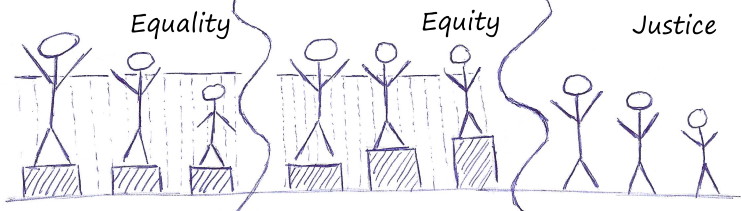
equality, equity, justice graphic

Justice: changing conditions, removing the barriers. Could not find the original source to credit, so I drew my own version of this thought-provoking graphic. I leave the sport being played behind the fence up to your imagination.

In Pursuit of Data and Algorithmic Equity

· 4 min read

Advances in the availability and breadth of data over the past few decades have enabled the rapid and unregulated deployment of statistical algorithms that aim to predict and thereby influence the course of human behavior. Most are designed to promote the corporate bottom line, not the welfare of the people. Those that aim to promote the common good run the danger of straying into authoritarian suppression of freedoms. Regardless of intention, these algorithms often reinforce existing social inequities or present a double-edged sword, with potential for positive use weighed against potential for misuse.

What's in a Name? Attitude.

· 5 min read

Last month my manager asked me about changing our naming convention for the primary "source of truth" in source code management: from "master" to… well, anything but "master." I admit to initial hesitancy. I needed to think about it. After all, it seems like the name derives from the multimedia concept of a "master copy." It's not like the terribly-named "master-slave" software and hardware patterns. Or is it?

Template Inheritance with TeamCity Kotlin

· 10 min read

This summer, one of the development teams at the Ed-Fi Alliance has been hard at work building Project Buzz: "When school shutdowns went into effect across the country as a result of COVID-19, much of the information teachers need to support students in the new online-school model had become fragmented across multiple surveys and the Student Information System." (Fix-It-Fridays Delivers Project Buzz, A Mobile App to Help Teachers Prepare for Back-to-School).

As project architect, my role has been one of support for the development team, guiding technology toolkit choices and supporting downstream build and deployment operations. The team agreed to develop the applications in TypeScript on both the front- and back-ends. My next challenge: rapidly create TeamCity build configurations for all components using Kotlin code.

Call for Community Expertise and Input – Ed-Fi in Containers!

· One min read

While the Ed-Fi Alliance has made investments to improve the installation processes for its tools, it is still a time–consuming task: easy to get wrong, you must have the right runtime libraries, and it is problematic to have multiple versions running on the same server.

What if end-users could quickly startup and switch between ODS/API versions, testing out vendor integrations and new APIs with little development cost and with no need to manage runtime dependencies? Docker containers can do that for us.

Continue reading on ed-fi.org

Potential Docker Architecture

Points on Bugs and Spikes

· 5 min read

Should bugs and spikes receive story points to aid in sprint capacity planning? Some teams will estimate all work items by time during sprint planning in order to find the right commitment. Many teams hate this and/or spend an inordinate amount of time arguing about time. Those that abandon time may be tempted to put points on these unplanned, non-productive items, but there is a cost: the completed velocity will overstate the projected release timeline for the remainder of the release backlog.

Possible solution: track the ratio of story to non-story points and use that to pad out the release projection estimate.

Splitting TeamCity Kotlin Into Multiple Files

· 4 min read

Motivation

I don't like having a single large file for a TeamCity project, which is the default when exporting a project. It violates the Single Responsibility Principle (SRP). For maintenance, I would rather find each element of interest — whether a sub-project, template, build step, or vcs root — in its own small file, so that I don't have to hunt inside a large file. And I would rather add new files than modify existing ones.

Is This a Good Idea?

This note about non-portable DSL explains the basic structure when you want to use multiple files. And yet I never noticed it while hunting in detail for help on this topic a week ago; only just stumbled on it while writing this blog piece. It seems to imply that using multiple files is "non-portable," but apparently I have been using the portable DSL: "The portable format does not require specifying the uuid", which I've not been doing.

There is a small risk that I could do something drastic and lose my build history without a uuid. Since I also have server backups, I'm not too worried. And in all of my experiments I've not been able to find any problems with this approach so far.

safnet logo